Braces Payment Plans: In-House vs Financing
Braces are paid over time far more often than in one go, because treatment itself runs for many months. There are two ways it is usually done.
In-house payment plans
The practice collects a down payment and spreads the rest over the treatment, billing you monthly. Many in-house plans charge no interest, because the practice is simply matching payments to the work. Some practices offer a discount for paying the whole fee up front instead — worth comparing against what your cash would otherwise earn.

Third-party financing
A lender pays the practice and you repay the lender. Promotional offers may charge no interest if the balance is cleared within the promotion; standard plans charge an APR from the start. Read whether a promotional rate is "deferred interest", which can backdate all the interest if any balance remains when the promotion ends.
What interest adds
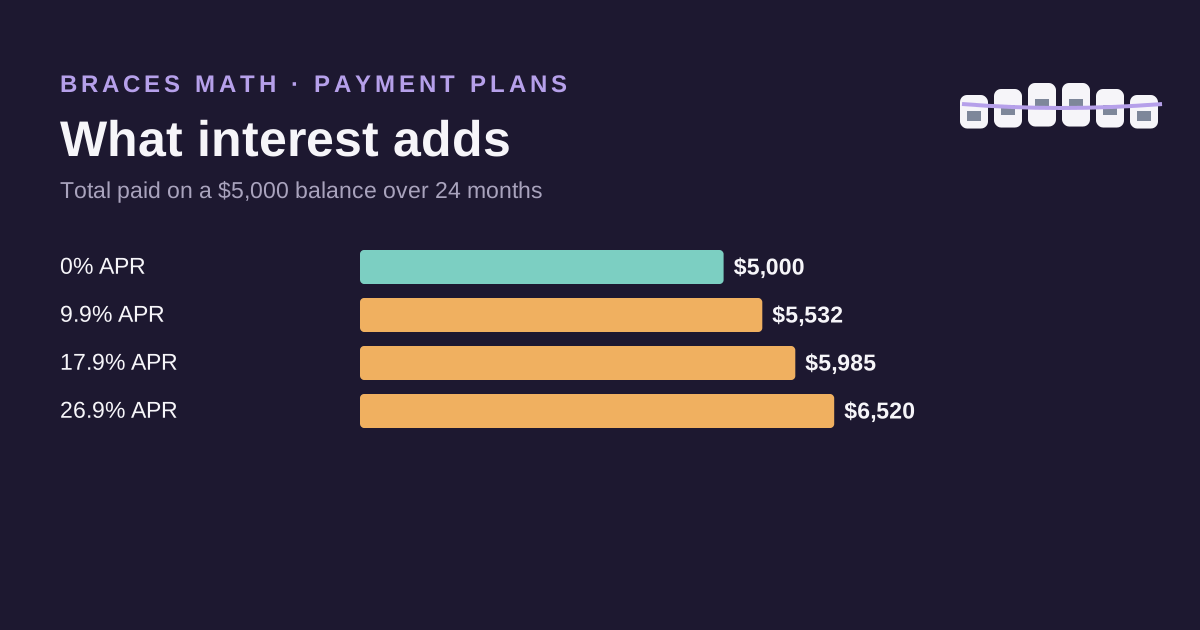
On a $5,000 balance over 24 months:
| APR | Monthly | Total paid | Interest |
|---|---|---|---|
| 0% | $208.33 | $5,000 | $0 |
| 9.9% | $230.49 | $5,532 | $532 |
| 17.9% | $249.38 | $5,985 | $985 |
| 26.9% | $271.65 | $6,520 | $1,520 |
These are computed with the standard loan formula, the same one the calculator uses; enter your own terms in the calculator.
Paying in full instead
If a practice offers a discount for paying the whole fee at the start, compare it with what the money would otherwise do. A 5% discount on $5,000 saves $250 at once; leaving the same $5,000 in a savings account paying 4% while you pay a 0% plan over two years earns very roughly $200, and less after tax. The closer the discount to your savings rate, the less it matters which you choose — and paying in full uses up cash you may want as a cushion.
Putting it together
Apply insurance first, then decide how much of the remainder to pay up front, how much to spread, and how much to route through an FSA or HSA. Paying the down payment and monthly payments from pre-tax money stacks the tax saving on top of a 0% plan.
Questions
Do orthodontists offer payment plans?
Many do, often spreading the balance over the treatment period after a down payment. Ask whether the plan charges interest and whether a discount is offered for paying in full.
Is orthodontic financing worth it?
At 0% a plan only spreads the cost. With interest it adds to it: the calculator shows how much for your balance, term and APR.