Using an FSA or HSA to Pay for Braces
IRS Publication 502 lists braces among the dental treatments that count as medical expenses. That makes orthodontic costs eligible for money in a health flexible spending account (FSA) or a health savings account (HSA), both funded before income tax.
What it's worth
Every dollar of braces paid from pre-tax money saves your income-tax rate on that dollar — and for FSA and HSA payroll contributions, usually Social Security and Medicare tax as well. At a 22% federal rate, $3,000 paid through an FSA saves about $660 of federal income tax alone. The calculator applies the rate you enter.
2026 limits
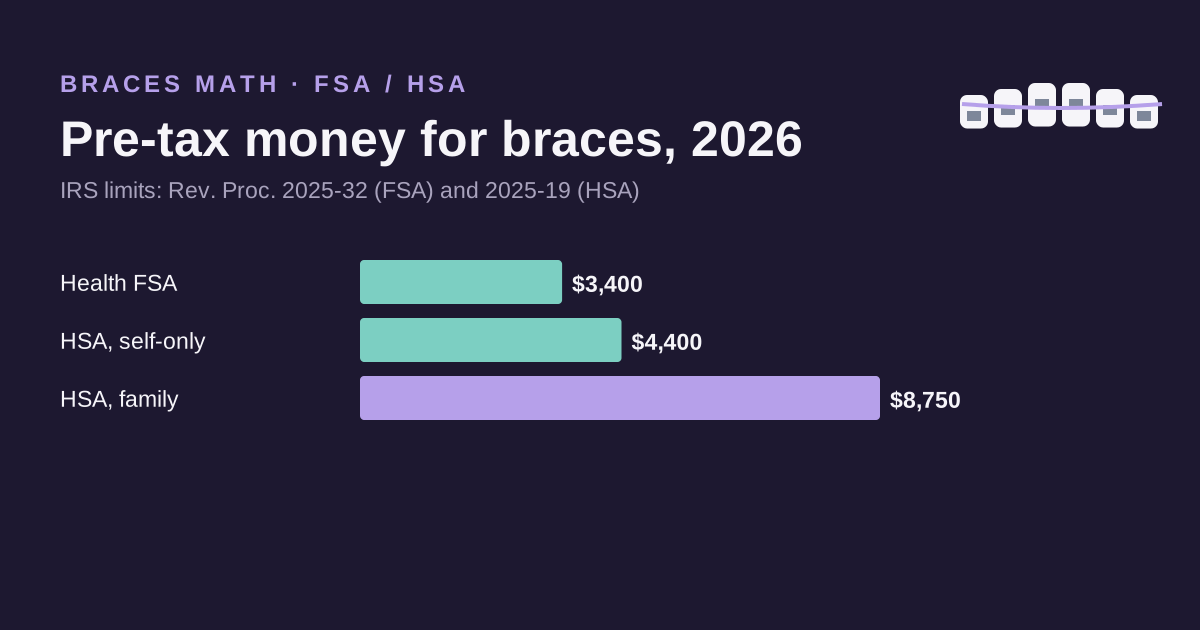
- Health FSA: $3,400 per employee; up to $680 can carry over to 2027 if the plan allows (Rev. Proc. 2025-32).
- HSA: $4,400 self-only, $8,750 family, plus $1,000 catch-up at 55 or older (limits from Rev. Proc. 2025-19; catch-up set by IRC §223(b)(3)(B)). You need a qualifying high-deductible health plan to contribute.
Timing
Orthodontic payment plans spread the cost over many months, which lets you use two plan years of FSA money on one course of treatment: fund the FSA in each year that payments fall. An FSA reimburses expenses as they are incurred and paid; for orthodontics many plans reimburse as you make payments, or the down payment up front — check your plan's rule. HSA money has no deadline: it stays in the account and can reimburse a qualified expense later, provided the HSA existed when the expense was incurred.
Two cautions
FSA money not used by the plan's deadline (beyond any carryover or grace period) is lost, so do not put in more than the payments you are sure to make. And insurance should be applied first: only the part you pay yourself can come from the FSA or HSA.
Questions
Can I use my FSA for braces?
Yes. IRS Publication 502 lists braces among dental treatment that counts as a medical expense, so they are eligible for a health FSA, an HSA or a limited-purpose FSA.
How much can I put in an FSA or HSA for 2026?
Up to $3,400 per employee in a health FSA (Rev. Proc. 2025-32), and up to $4,400 self-only or $8,750 family in an HSA, plus $1,000 catch-up at 55 or older (Rev. Proc. 2025-19; the catch-up is set by IRC §223(b)(3)(B)).