Does Dental Insurance Cover Braces?
Many dental plans include an orthodontic benefit, and many don't. Where it exists it is built from four parts, each listed in the plan's summary of benefits.
The four parts
- Coverage percentage. The share of the orthodontic cost the plan pays, often stated as a percentage such as 50%.
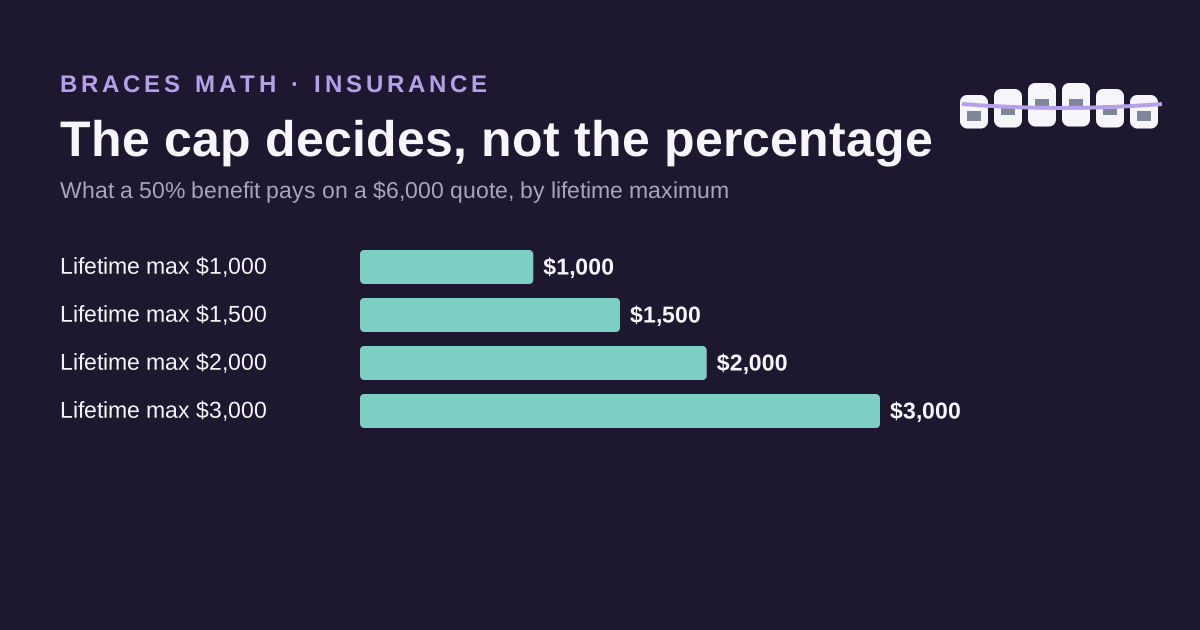
- Lifetime maximum. A cap on what the plan pays for orthodontics per person, ever — separate from the plan's annual maximum for other dental work. This cap, not the percentage, usually decides what you get back.
- Age limit. Many plans cover orthodontics only for dependent children up to a stated age.
- Waiting period. Some plans require you to be enrolled for a period before orthodontic benefits start.
How the cap works
Take a $6,000 quote and a plan paying 50%. Without a cap the plan would pay $3,000. With a $1,500 lifetime maximum it pays $1,500; with $2,000 it pays $2,000. Only a cap above $3,000 would let the full 50% through. Try your own figures in the calculator.
How the money arrives
Insurers usually pay orthodontic benefits in stages — an initial payment when treatment starts, then smaller payments over the treatment period — rather than in one lump. If you change jobs or plans mid-treatment, payments under the old plan generally stop, and a new plan may treat the case as already in progress. Ask both insurers before you switch.
Before you start treatment
Ask the orthodontist's office to submit a pre-treatment estimate to your insurer. It returns in writing what the plan expects to pay, so the gap you need to fund — through a payment plan or an FSA or HSA — is known in advance.
Questions
Does dental insurance cover braces for adults?
Some plans do, but many limit orthodontic benefits to dependent children under an age set in the plan. Check the plan's benefit summary for an age limit.
What is an orthodontic lifetime maximum?
The most the plan will ever pay toward orthodontic treatment for one person. Once it is reached, the plan pays nothing more for orthodontics, whatever the coverage percentage.